

Significant changes are coming to the Oregon Health Plan. Effective Jan. 1, 2027, the Oregon Health Authority will phase out the traditional Medicaid Prioritized List waiver to align with federal Centers for Medicare & Medicaid Services requirements. The plan is transitioning to a category-based service model designed to streamline benefits and expand care.
Here is what you need to know to prepare for the upcoming transition.
The ranked Prioritized List is evolving. While the Health Evidence Review Commission will still manage clinical guidelines, the structure of Oregon Health Plan coverage is changing in three ways:
| Area | What is changing |
|---|---|
| Expanded clinical coverage | No existing benefits are being cut. Coverage will expand to include medically necessary treatments for some conditions previously below the funding line, such as fibromyalgia and tension headaches. |
| Service denials | Denials will no longer be based on a service’s position on the Prioritized List or whether it was below the funding line. |
| Prescription drug coverage | Most FDA-approved drugs must have a pathway to coverage when medically necessary and appropriate, unless excluded under Oregon Administrative Rules. Coordinated care organizations and the Oregon Health Authority may still use prior authorization, preferred drug lists and step therapy. |
| Oral health benefits | No changes are planned as part of the Benefit Update Project transition. Other changes may occur through separate rulemaking. Visit the Oregon Health Plan Dental Benefits page for more information. |
| Behavioral health benefits | Coverage will expand to include psychotherapy for some additional diagnoses, including somatization disorders, somatoform disorders and chronic pain disorders, when medically necessary. |
| Guideline notes | Some guideline note criteria will be restructured to support the transition to the new category-based framework. |
| Area | What stays the same |
|---|---|
| Prior authorization requirements and processes | Prior authorization will still be required for some services. Continue using the same prior authorization and claims submission processes. |
| Prioritized List guidance | The Oregon Health Authority will continue to provide treatment-condition code pairings and guideline notes, with some updates, to help you make medical necessity decisions. The list will still be called the Prioritized List, but it will no longer include a funding line or identify services as “not covered” or “unfunded.” Instead, it will include only services and treatments that are presumptively covered by Oregon Medicaid. You can continue to use the list as a general guide to what the Oregon Health Plan covers. |
| Excluded services | Services on the excluded services list will remain non-covered. |
| Cosmetic and not medically necessary treatments | These will still not be covered, nor will weight loss medications for adults when used solely for weight management. |
| Prior authorization timelines | Timelines for completing prior authorization reviews will remain the same. |
Many patients on the Oregon Health Plan have questions about how the changes coming with H.R. 1 might affect their care. We want to help you answer them.
We wrote patient-friendly content that you can post on your clinic’s website, patient portal or other patient materials. It points patients to trusted sources and tells them what to do now. Copy it from this article and adjust it for your practice.
H.R. 1 Information for [Provider Name] Patients
We know that patients on the Oregon Health Plan have questions about how the changes coming with H.R. 1 might affect their care. We want to help you find the answers.
Where to Learn More
You can stay up to date with the latest information on the Oregon Health Authority website. You can also visit the Umpqua Health Alliance website for an overview of how H.R. 1 will affect members and links to more information.
What You Can Do
The most important thing you can do right now is make sure your contact information is up to date with OHP. You must tell OHP if your mailing address, email, phone number or other information changes.
You can report changes online, in person, by phone or by mail. Learn more about when and how to report changes on the OHP website. You can also ask an OHP-certified assister for help. We have [one/several] on our team. [Include this sentence only if your clinic has assisters.]
OHP will send you notices when it is time to renew. Make sure you open and respond to any letters OHP sends you. If you have questions about H.R. 1 or a notice from OHP, call 1-800-699-9075 or TTY 711.
Healthier Oregon Members
In January 2027, federal changes mean all Healthier Oregon OHP members will move to OHP Open Card. If you are a Healthier Oregon member, OHA sent you a letter with more information about this change in October 2026.
Option 1: For clinics that accept OHP Open Card
Don’t worry. We accept OHP Open Card, which means Healthier Oregon members can continue to see their existing primary care provider with our team.
Option 2: For clinics that do not accept OHP Open Card
Unfortunately, we do not currently accept OHP Open Card. Beginning Jan. 1, 2027, Healthier Oregon members will no longer be able to see providers at [Provider Name]. However, many local providers do accept OHP Open Card. You can call OHP Care Coordination at 800-562-4620 (Monday through Friday, 8 a.m. to 5 p.m.) for help finding one.
Have Questions?
Call us or let us know at your next visit. We have [an OHP-certified community assister/OHP-certified community assisters] on our team who can answer your questions or even help you with your next renewal. [Include this paragraph only if your clinic has assisters.]
Effective Oct. 13, 2026, the Oregon Health Authority moved payment responsibility for specified gender-affirming medications and surgical procedures for Oregon Health Plan members younger than 18 from coordinated care organizations to OHP Open Card, the fee-for-service program.
| Service | Who is responsible |
|---|---|
| Specified gender-affirming medications, including hormone therapies and puberty blockers | OHP Open Card |
| Surgical procedures on the carve-out code list | OHP Open Card |
| Office visits, laboratory services, other ancillary services and care coordination | Coordinated care organization |
Affected services: The change applies to specified gender-affirming medications, including hormone therapies and puberty blockers, and to surgical procedures for OHP members younger than 18.
Claims submission: Submit claims for services on the Oregon Health Authority’s carve-out code list to OHP Open Card for dates of service on or after Oct. 13, 2026. Bill these services separately from non-carved-out services.
Services that remain with the CCO: The coordinated care organization remains responsible for all other covered gender-affirming care services, including office visits, laboratory services, other ancillary services and care coordination.
Provider enrollment: You must be enrolled with OHP Open Card to continue providing and billing for affected services through this payment pathway.
The Oregon Health Authority will honor existing CCO prior authorization approvals for affected services under its transition-of-care rules. Follow the agency’s current instructions for submitting new prior authorization requests for carved-out medications and surgical procedures.
We encourage you to review the Oregon Health Authority’s guidance and code list to identify affected services and confirm the appropriate billing and prior authorization requirements.
For help with OHP Open Card enrollment, contact OHA Provider Services at 800-336-6016, option 6
Umpqua Health Alliance Care Coordination supports members whose needs extend beyond a clinical visit. Our multidisciplinary team of registered nurses, social workers, respiratory therapists and care navigators works with members to develop personalized care plans, understand health conditions, manage medications, coordinate appointments and connect with community resources such as food, housing, transportation and other social supports.
To ensure we receive and process referrals promptly, use the Case Management Referral Form.
Submit completed referrals using one of the following options:
| Method | How to submit |
|---|---|
| CaseManagement@umpquahealth.com | |
| Fax | 541-229-8180 |
| Phone | Call Customer Care at 541-229-4842, toll-free 866-672-1551 or TTY 711, and ask for the Care Coordination Department. |
To help us route referrals quickly and accurately, do not email or call individual Care Coordination staff members directly.
Using the official referral process allows our Care Navigation Team to review, prioritize and route each referral to the appropriate team member.
We process referrals most efficiently when they include:
| Step | What happens |
|---|---|
| 1. We review | Once we receive a referral, our Care Navigation Team reviews it and assigns it to the most appropriate care coordination staff member based on the member’s identified needs. |
| 2. We contact the member | A member of the Care Coordination team will contact the member within 24 hours of receiving the referral to complete a health risk assessment and begin addressing identified needs. |
| 3. You receive confirmation | You will also receive confirmation within 24 hours that we received your referral. If you want ongoing updates, contact the Care Coordination Department through Customer Care. |
Depending on a member’s needs, we may provide support through:
Our team determines the most appropriate level of support based on the member’s physical health, behavioral health, dental and social needs.
You do not need to determine whether a member qualifies for care coordination services before submitting a referral. If a member may benefit from additional support, refer them.
Members can also complete a health risk assessment online at UHA Health Risk Assessment. The assessment helps identify areas where additional support may be beneficial. After we receive it, a care coordination staff member will contact the member directly, address identified needs and connect the member with the staff member best suited to provide ongoing support.
For referral assistance or staff training on the referral process, contact:
Care Coordination
Phone: 541-229-4842
To support timely access to medication and reduce administrative delays, Umpqua Health Alliance has outlined key requirements for submitting pharmacy prior authorization requests. You can find a complete list of covered medications in the Drug List and Prior Authorization section of our website.
All pharmacy prior authorization requests must be submitted directly by your office. We do not accept third-party submissions from platforms such as CoverMyMeds, and we will dismiss them.
We recommend using the Community Integration Manager to submit, track and manage prior authorization requests. CIM streamlines the process by reducing paperwork and enabling direct communication with our Member Services, Prior Authorization and Claims teams. All in-network providers are required to have CIM access. To enroll, email PriorAuthorizations@umpquahealth.com.
Include the following information with every request:
We place incomplete requests in the Additional Information queue and hold them for up to 72 hours before dismissal.
| Benefit type | Form to use |
|---|---|
| Medical benefit (such as infusions and injections) | Professionally Administered Drug prior authorization form |
| Pharmacy benefit | Medication prior authorization form |
You can find the forms and our drug list at umpquahealth.com/pharmacy-services.
For help with prior authorization, email our team at UHPharmacyServices@umpquahealth.com.
Effective Nov. 1, 2026, Umpqua Health Alliance enforces its existing requirement that providers submit a complete credentialing application before the credentialing period begins and in-network reimbursement provisions take effect.
This requirement aligns with Oregon House Bill 3242 (2025), which amended Oregon Revised Statutes 743B.454. Under the law, the credentialing period begins when we receive a complete application. It ends when we approve or deny the application or 90 days after receipt, whichever comes first.
For providers joining a group that is already in network, we must pay claims for covered medical services provided during the credentialing period at the same rate and on the same payment schedule as claims from in-network providers.
We consider a credentialing application complete only when it includes all of the following information and documentation:
We consider applications that are missing any required information or documentation incomplete. The credentialing period does not begin until we receive a complete application. As a result, claims are not eligible for in-network reimbursement under the credentialing-period provisions until we receive a complete application.
If more than 120 days have passed since you submitted your complete credentialing application and you have not received an update, contact Credentialing@DCIPA.com.
For questions about your effective date or billing, contact Provider Relations at UHNProviderServices@umpquahealth.com.
The Background Check Unit is proposing to update its administrative rules on three topics:
Proposed rule topics
The Notice of Proposed Rulemaking includes
The deadline to submit comments to the agency is 4 p.m. Nov. 20, 2026. The agency will post all comments it receives about these rules on the ODHS | OHA rules website for public transparency.
We recently added Collaborative Social Needs Screening and Referral Training to the Quality Incentive Program page of our website. Visit the page to find the training and other resources for providers.

The Southwestern Oregon Workforce Investment Board, known as SOWIB, is implementing the RHTP Catalyst project. Its Traditional Health Worker (THW) Pathway Advisory Committee provides experience, perspective and practical guidance. The committee helps ensure the project responds to rural THW workforce needs, builds on existing regional resources and supports new or expanded, non-duplicative work within the Oregon Health Authority-approved project plan and budget. It also provides a trusted space for partners to help strengthen implementation and build a more connected THW pathway.
| Advise and provide feedback Share your expertise and perspective on rural THW workforce needs, barriers and opportunities. Review project activities, approaches, tools and emerging priorities, and offer practical recommendations to strengthen implementation. | Identify gaps and opportunities Help identify barriers and opportunities along the pathway from training to certification to employment to rural service. Point to resources, partnerships and regional efforts that can strengthen the project. |
| Support coordination Help SOWIB understand how Catalyst activities can complement existing programs and initiatives. Identify opportunities for collaboration and alignment while avoiding duplication. | Participate and engage Attend monthly Advisory Committee meetings and take an active part in discussion and problem-solving. Review materials in advance when requested, provide timely feedback and stay in touch with SOWIB and other committee members between meetings as needed. |
The Advisory Committee meets monthly, generally for 60 to 90 minutes. Members may also review materials or complete follow-up activities between meetings. SOWIB expects members to participate consistently and to communicate when they are unable to attend.
SOWIB’s Traditional Health Worker Pathway Communications Ad Hoc Committee brings together on-the-ground perspectives to help shape a social media and communications strategy. The strategy aims to reflect the real experiences of people involved in THW training, certification and employment. The committee is launching alongside the project’s Advisory Committee.
Members include THW trainers, RHTP awardees and staff, SCREL staff, workforce and WorkSource partners, community organizations, employers and others connected to THW training, certification, employment or rural workforce development.
| Share insights Offer on-the-ground perspectives from your community or organization to inform messaging and outreach. | Shape messaging Help ensure communications reflect authentic experiences rather than just program talking points. |
| Connect the work Help link communications efforts to the broader THW Pathway initiative and its goals. | Collaborate Participate in committee meetings and activities, working alongside other regional partners involved in similar efforts. |
As a committee member, you will have opportunities to:
This is an ad hoc committee. Meeting frequency and time commitment will be confirmed as the committee is established.

Lines for Life, in collaboration with the Oregon Health Authority and Jackson Care Connect, is convening regional change agents at the first Southern Oregon Regional OPAT Summit. Registration is still open.
When: Nov. 13, 2026, 9 a.m. to 3 p.m.
Where: Bigham Knoll Campus, 525 Bigham Knoll Drive, Jacksonville, OR 97530
Cost: Registration is free, and lunch will be provided.
Building on the vision of the statewide OPAT Conference, the regional summit aligns directly with the core priorities of the Oregon Alcohol and Drug Policy Commission Comprehensive Plan.
The Southern Oregon schedule prioritizes prevention first, transitions to specialized care and concludes with clinical and crisis interventions. The agenda will explore integrated models of care, including a “Treatment Now” approach and prescribing of medications for alcohol use disorder and opioid use disorder alongside ongoing recovery supports.
Attendees will learn about innovative strategies that local providers are implementing — including La Clinica, Rogue Community Health, Continuum Recovery, Addictions Recovery Center, Jackson County Mental Health and Mercy Flights. In addition to hearing from local experts, participants will take part in facilitated small- and large-group discussions aimed at identifying common regional barriers and developing practical, creative solutions.
The summit is designed for professionals who address substance use disorder prevention, treatment and care coordination across Southern Oregon, including:
Approval is currently under way for both National Association of Social Workers continuing education units and continuing medical education credits.
Attendees will work together to develop community-rooted strategies that reflect local values and voices.
For event questions, email events@linesforlife.org.
This virtual workshop series equips health care providers with essential skills for effective vaccine discussions. The program offers an in-depth introduction to the principles of motivational interviewing, or MI, and focuses on applying them to conversations about vaccines. The Oregon Health Authority’s Transformation Center is sponsoring the trainings in partnership with Boost Oregon.
Audience: Health care providers and immunizers
Continuing medical education: The American Academy of Family Physicians has reviewed “Navigating Vaccine Conversations: The Motivational Interviewing Approach” and deemed it acceptable for AAFP credit. The term of approval is Oct. 1, 2026, to Oct. 1, 2027. AAFP members should claim only the credit commensurate with the extent of their participation in the activity.
You can find full descriptions on each registration page and on the immunization technical assistance page.
| Session | Date and time | Registration | Credits |
|---|---|---|---|
| Session 1 of 3: “The Spirit of MI: The Heart Behind the Conversation” | Feb. 3, 2027, 7 to 9 a.m. | Register for Feb. 3 | 2.0 CME credits |
| Session 2 of 3: “Core Skills: Asking Better Questions and Reflecting What You Hear” | Feb. 10, 2027, 7 to 9 a.m. | Register for Feb. 10 | 2.0 CME credits |
| Session 3 of 3: “Giving Information the MI Way: Advice Without Undermining Autonomy” | Feb. 17, 2027, 7 to 9 a.m. | Register for Feb. 17 | 2.0 CME credits |
For training questions, email training@boostoregon.org. To request an accommodation, email Transformation.Center@odhsoha.oregon.gov or call 503-381-1104.

The Healthy Start program is growing. Members ages 7 to 14 can now earn gift cards worth up to $75 as a thank you for completing a preventive dental checkup or catching up on important immunizations by Dec. 31, 2026. The immunizations are:
Tell families of members ages 7 to 14 about this added incentive for keeping their children healthy.
Our Pharmacy and Therapeutics Committee has approved adding Zepbound (tirzepatide) KwikPen to the formulary with a prior authorization requirement. KwikPen offers a lower-cost alternative to the Zepbound single-dose pen while providing the same active ingredient.
| Feature | Zepbound single-dose pen | Zepbound KwikPen |
|---|---|---|
| Active ingredient | Tirzepatide | Tirzepatide |
| Device | Single-dose pen | Multidose device |
| Cost | Higher | Lower |
| Prior authorization | Existing requirements | Required |
For questions or assistance, contact Pharmacy Services at 541-673-1462, Monday through Friday, 8 a.m. to 5 p.m. Pacific time.
Effective Jan. 1, 2027, we will remove Steglatro (ertugliflozin) from our formulary. Dapagliflozin, a lower-cost SGLT2 inhibitor, will remain a preferred formulary option and is available without prior authorization.
Dapagliflozin offers benefits beyond glycemic control, with FDA-approved indications for adults with type 2 diabetes, certain members with heart failure and members with chronic kidney disease who are at risk of progression.
| Medication | Change | Effective | Prior authorization |
|---|---|---|---|
| Steglatro (ertugliflozin) | Removed from formulary | Jan. 1, 2027 | Not applicable |
| Dapagliflozin | Remains a preferred formulary option | Ongoing | Not required |
Dapagliflozin does not require prior authorization, which simplifies prescribing and reduces your administrative workload.
Our Pharmacy Services team will conduct targeted provider and member outreach to support this change and help prevent interruptions in medication therapy.
For questions or assistance, contact Pharmacy Services at 541-673-1462, Monday through Friday, 8 a.m. to 5 p.m. Pacific time.
The Great American Smokeout, an American Cancer Society event, takes place Thursday, Nov. 19. It is a good time to remind your patients that help with quitting tobacco is free and available now.
Our member flyer, “Free Help to Quit Tobacco,” lists free services that members can use at any time. Members do not have to quit today to use them. Support can make quitting easier and more comfortable when they decide to take a step.
| Resource | What it offers |
|---|---|
| Oregon Quitline | Patients can talk or text with a quit coach 24 hours a day, seven days a week. Text READY to 34191, call 1-866-784-8454 or visit quitnow.net/oregon. English and Spanish are available, as is TTY. |
| Online tools | Smokefree.gov offers free quit plans, text programs, apps and expert tips for adults, teens, veterans and people who are pregnant. The American Cancer Society offers step-by-step guidance to help people decide to quit and manage cravings. The American Lung Association offers tools, programs and support to help protect lung health. |
| Free apps | quitSTART provides tips, motivation and tools to manage cravings. QuitGuide helps users track cravings and progress toward smoke-free goals. |
| Medication | The Oregon Health Plan covers nicotine patches and gum at no cost with a prescription. Some pharmacies can prescribe quit medications. |
| Quitting vaping | Support is available for ages 13 to 26 at livevapefree.com. |
You can help patients choose the support that fits them, prescribe medication or connect them with counseling. Dentists and pharmacists can do the same.
Customer Care can help members decide which resource may work best. The team is available Monday through Friday, 8 a.m. to 5 p.m. Call 541-229-4842, toll-free 866-672-1551, or TTY 541-440-6304 or 711. You can also email UHCustomerCare@umpquahealth.com or CaseManagement@umpquahealth.com.
Source: Guideline Watch, NEJM Journal Watch
Dr. Teshamae Monteith and Dr. Christopher W. Goodman
Reviewing: Neurology
The latest recommendations support calcitonin gene-related peptide (CGRP) inhibitors, propranolol, topiramate and valproate as first-line treatments. The guideline also recommends onabotulinumtoxinA for chronic migraine.
Guideline reference: “An overview of Pharmacologic Treatment for Migraine Prevention in Adults Practice Guideline Recommendations: Report of the AAN Guidelines Subcommittee and the American Headache Society” (2026).
The American Academy of Neurology and the American Headache Society have updated their 2012 guideline on migraine prevention in adults. To develop the latest recommendations, they conducted a systematic review of more than 200 randomized, controlled studies published through mid-2024.
| Group | Recommended medications |
|---|---|
| Episodic migraine | For episodic migraine (fewer than 15 headache days per month), first-line medications include propranolol, topiramate, valproate and the following CGRP inhibitors: atogepant, eptinezumab, erenumab, fremanezumab and galcanezumab. |
| Second-line options | Second-line medications include amitriptyline, flunarizine, metoprolol, pizotifen, rimegepant and telmisartan. |
| Chronic migraine | For chronic migraine (15 or more headache days per month for more than three months, with migraine features on at least eight days), first-line medications include topiramate, valproate, onabotulinumtoxinA and the CGRP inhibitors listed above. |
This guideline supports what we do in clinical practice: stratifying treatment options based on patient preferences and comorbidities. It also provides guidance on when to initiate, assess, modify and discontinue preventive treatment. The evidence review cutoff was in 2024, so recent studies were excluded, including studies of rimegepant and candesartan, a good option for hypertensive patients. Although the guideline does not specify it, CGRP inhibitors also should be avoided during pregnancy.
The American College of Physicians published a guideline on migraine prophylaxis in 2025. It is worth noting one key difference: The neurology guideline lists CGRP inhibitors as first-line options, whereas the American College of Physicians recommends them as second-line options. However, both guidelines acknowledge that CGRP inhibitors are probably at least as effective as older drugs and that cost and insurance coverage remain significant barriers for many patients.
Umpqua Health Alliance and the Oregon Health Plan follow a principle of stewardship that promotes the least costly alternative as first-line treatment, similar to the American College of Physicians guideline. Review our formulary and prior authorization criteria when prescribing drugs for migraine.

Many people have not experienced poverty firsthand, and it can be difficult to understand. The Community Action Poverty Simulation, known as CAPS, is an interactive immersion experience that helps community members understand the realities of poverty.
During the simulation, participants walk a month in the shoes of someone whose basic needs are not being met, such as a single parent, an older adult or a young adult with incarcerated parents. Afterward, participants unpack what they learned and brainstorm community change.
When: Thursday, Nov. 12, 9 a.m. to noon
Where: Aviva Health, second floor, 150 NE Kenneth Ford Drive, Roseburg, OR 97470
Schedule: Registration, 9 to 9:30 a.m.; poverty simulation, 9:30 to 11 a.m.; debriefing, 11 a.m. to noon
Cost: The event is free, but spaces are limited.
“This simulation dramatically demonstrates how much time and energy many families have to give to survive from day to day. It quickly dispels the myth that people would do fine if they would only go out and get a job!”
The event aims to build greater understanding, examine bias, transform perspectives and start important conversations about our community’s needs.
For more information, contact McKenzy Schultz at mckenzy@peaceathome.com or Amy Taylor at ataylor@umpquachc.org.
We are pleased to share that our local health care interpreters, Ana Garcia, Gaby Rosales and Maria Salazar, received the Health Equity Champion Award at the 82nd Oregon Public Health Association Conference.
Many of you already know Ana, Gaby and Maria and have seen firsthand the work they do for the Spanish-speaking community in Douglas County. Since July 2024, the team has provided interpretation services for more than 1,600 medical visits.
Their impact goes beyond interpretation. They are trusted advocates who work to ensure patients feel heard, respected and supported. From helping families navigate challenging health care experiences to advocating for changes in hospital practices, their dedication has made a meaningful difference in our community.
Although they could not attend the conference in person, they shared this message:
“Thank you to everyone who trusted us to help bridge the language gap in healthcare. It is a privilege to serve our Spanish-speaking community, and we’re grateful for every opportunity to help patients be heard and understood.”
We are proud to work alongside Ana, Gaby and Maria, and we are glad to see their hard work and compassion recognized statewide.
Please join us in congratulating our Health Equity Champions.
Community programs offer a practical way to connect clinical guidance with daily routines. The ongoing activities described here are free, locally available and designed for consistent participation. You can align these options with care plans when community-based support is appropriate.
When: Wednesdays, noon to 1 p.m., through Dec. 16
Where: The Vortex Center, 865 SE Court Ave., Roseburg
This class combines midday mobility, intentional breathwork and gentle stretching to release tension and increase focus. Suitable for all levels, it encourages participants to reconnect with their bodies, find balance and return to the day feeling refreshed and centered. No registration is required.
When: Second Saturday of each month, 4 to 5:15 p.m.
Where: The Vortex Center, 865 SE Court Ave., Roseburg
This monthly restorative yoga session focuses on relaxation and stress reduction.
The group helps participants improve their health through natural movement, get to know new friends, connect with nature and talk casually about nutrition-related topics with a registered dietitian.
When: Every second and fourth Tuesday of the month, 9 to 10 a.m. In November, the group meets Nov. 10 and Nov. 24.
Where: Millsite Park in Myrtle Creek. Meet at the covered bridge at the southeast end of the park.
Who: Everyone is welcome.
For more information, contact Claire Grubb, a registered dietitian, at 541-672-8533, ext. 5266.

The following tables list providers who recently left or joined our network, with effective dates.
| Provider Name | Effective Term Date | Group |
|---|---|---|
| Brooks Hunsaker, DMD | 09/04/26 | Siskiyou Community Health Center Grants Pass and Cave Junction |
| Olaifa Turner, DMD | 08/30/26 | Advantage Dental — Reedsport |
| Jeffrey Rees, MD | 10/05/26 | CEP America — Anesthesia |
| Philip Groesbeck, MD | 10/05/26 | CEP America — Anesthesia |
| Sean Myers, QMHP-R | 10/09/26 | Adapt Integrated Health — MH Division |
| Amber Cooper, MSN, PMHNP-C | 10/09/26 | Cow Creek Health and Wellness — Canyonville and Roseburg |
| Karla Whitlock, LPC | 07/31/25 | Adapt Integrated Health — MH Division |
| Owen Matherly, MSW, LCSW | 10/09/26 | Joyful Living Behavioral Health |
| Safaa Elnour, QMHP-R | 10/08/26 | Adapt Integrated Health — MH Division |
| Roger Kennedy, LPC | 10/06/26 | 4 Badges Counseling |
| Julie Leister, PMHNP | 10/16/26 | Umpqua Health Newton Creek |
| Jose Rodriguez, NP | 10/12/26 | PeaceHealth — Cottage Grove and Florence |
| Kyra Schultz, CADC-R | 09/22/25 | Serenity Lane |
| Provider Name | Effective Date | Facility |
|---|---|---|
| Michael Purcell, DDS | 10/01/26 | Little Ducks Pediatric Dentistry |
| Jacey Ashley, QMHP-R | 09/17/26 | Adapt — MH Division |
| Michael Parr, PMHNP | 10/20/26 | Adapt — Primary Care Roseburg |
| Brenda Butterfield, QMHA | 10/20/26 | Oregon Outreach Clinic |
| Peter Clemens, DO | 10/20/26 | Three Rivers Health Center |
| Kip Colvey, PA | 10/20/26 | Slocum Orthopedics |
| Anna Crumrine, PA | 10/20/26 | Jorgensen Family Medicine |
| Erin Davis, QMHA-R | 10/20/26 | True Hope Counseling |
| Spencer Dowdle, MD | 10/20/26 | Slocum Orthopedics |
| McKenzie Gambaro | 10/20/26 | Oregon Outreach Clinic |
| Timothy Herd, MD | 10/20/26 | Kids Docs PC |
| Lisa Hobart, PAC | 10/20/26 | Slocum Orthopedics |
| Rudolf Hoellrich, MD | 10/20/26 | Slocum Orthopedics |
| Jacqueline Kaplan, PA | 10/20/26 | Slocum Orthopedics |
| Julian Klosowiak, MD, PhD | 10/20/26 | Slocum Orthopedics |
| Michael Koester, MD | 10/20/26 | Slocum Orthopedics |
| Trisha Lacey, PA | 10/20/26 | Slocum Orthopedics |
| Caitlin Lee, PA | 10/20/26 | Slocum Orthopedics |
| Steven Orton, PA | 10/20/26 | Slocum Orthopedics |
| Jason Queer, PAC | 10/20/26 | Slocum Orthopedics |
| Zachary Roth, PA | 10/20/26 | Slocum Orthopedics |
| Jason Salden, PA | 10/20/26 | Slocum Orthopedics |
| Kymry Scott, NP | 10/20/26 | Slocum Orthopedics |
| Luke Seidel, PA | 10/20/26 | Slocum Orthopedics |
| Kayla Stevens, PA | 10/20/26 | Slocum Orthopedics |
| Anna van der Host, MD | 10/20/26 | Slocum Orthopedics |
| Jennifer Schenk, MSN, FNP | 10/20/26 | Three Rivers Health Center |
| Ryan Todd, MD | 10/20/26 | Valley Ridge Family Medicine |
| Amy Lamb, FNP | 10/20/26 | White Oak Medical Clinic |
| Connell Bost, MD | 10/13/26 | PeaceHealth Medical Group |
| Christopher Standley, DO | 10/03/26 | PeaceHealth Medical Group |
| Lance Caddy, MD | 07/01/26 | CEP America — Anesthesiology |
| Matthew Lail, CRNA | 07/01/26 | CEP America — Anesthesiology |
| Benjamin Kam Jr., MD | 10/20/26 | PeaceHealth — Florence Orthopedics |
| William Schumacher, PAC | 10/20/26 | PeaceHealth — Cottage Grove and Florence Emergency Medical Centers |


Plague is caused by Yersinia pestis, an ancient bacterium that has wreaked havoc throughout human history. Humans can become infected through flea bites, handling an infected animal, contact with contaminated fluid or tissue, or inhaling droplets.
There are three clinical forms of plague: bubonic, pneumonic and septicemic.
| Form | What to know |
|---|---|
| Bubonic | The most common form. It is spread by the bite of an infected flea and results in swollen lymph nodes called buboes. |
| Septicemic | Occurs when the bacteria have entered the bloodstream. |
| Pneumonic | Occurs when the bacteria spread to the lungs. It is the only type that can be spread from person to person, through coughed droplets. |
Without treatment, pneumonic plague has a fatality rate of nearly 100%, and even with antibiotic treatment it has a fatality rate of 50% to 60%. Pneumonic plague is the only type that can be spread from person to person, through coughed droplets. For this reason, it is important that patients be cared for under standard and droplet precautions until at least 48 hours after they start antibiotic therapy.
Plague occurs naturally in wild animals in the western United States, including Oregon. Fleas carry plague among rodents such as ground squirrels, prairie dogs, chipmunks, wood rats and mice, and among predators that eat these wild rodents, such as bears, bobcats, mountain lions and, occasionally, domestic cats and dogs. Human infections are rare and usually bubonic. About five cases are reported annually in the U.S., usually in New Mexico or Arizona. The most recent case in Oregon occurred in 2024, when a Deschutes County man contracted bubonic plague from his cat, which likely caught it from rats or flea bites. The man was treated quickly and recovered, though the cat did not survive. To help prevent plague, advise patients to reduce rodent habitats around their homes, treat pets for fleas, wear gloves when handling or skinning dead animals and use insect repellent.
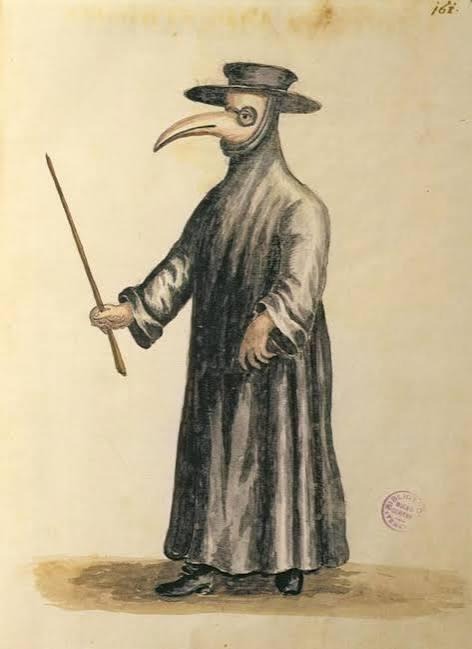
Jan van Grevenbroeck, a 17th-century Venetian doctor, wearing a plague mask. (National Geographic)
Plague has been in the news recently following reports of the death of a Russian laboratory researcher in Siberia. Yersinia pestis is a pathogen of concern for bioterrorism because it can spread from person to person and rapidly cause fatal disease. For this reason, it is immediately notifiable to public health, day or night.
Pneumonic plague has a short incubation period, usually one to four days but sometimes as short as a few hours. In the event of a possible intentional plague release, public health departments would likely hold large drive-through events to dispense seven-day courses of doxycycline to those exposed. Treatment is simple, but timing is of the essence. Postexposure prophylaxis, or preventive antibiotic treatment, should be given as soon as possible after exposure. Treatment should begin within 24 hours when symptoms develop, without waiting for laboratory confirmation.
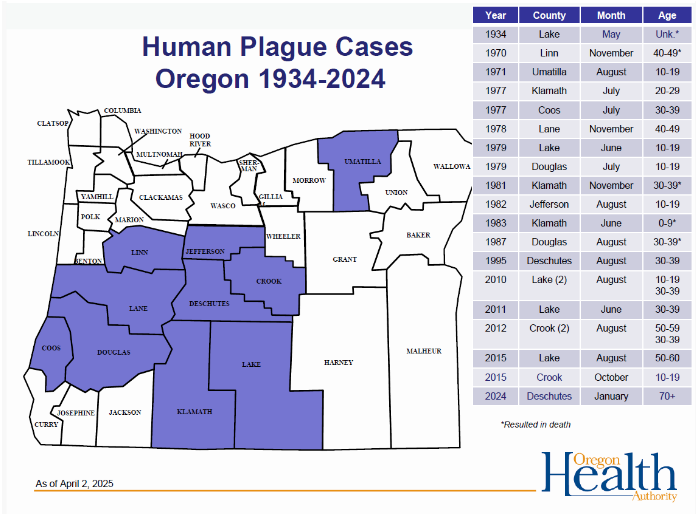
Human plague cases in Oregon, 1934-2024. Source: Oregon Health Authority, as of April 2, 2025.


Good oral health is closely linked to overall health, and the habits children form early can shape their health for life. Advantage Dental+ reminds families that dental care involves more than treatment. It also means learning how to maintain oral health at home between visits.
Dental visits also count toward the Healthy Start gift card for members ages 7 to 14. Read more in this issue’s Clinical Corner.


